Best student credit cards in Canada
Student credit cards for people with little or no credit history, ranked by what they earn after fees.
Card details updated November 9, 2026 How we rank
What’s in each?
- Light:
- Groceries $400, restaurants $100, gas $100, recurring bills $100, everything else (base rate) $250, foreign currency $50
- Typical:
- Groceries $800, restaurants $250, gas $250, recurring bills $250, travel $150, everything else (base rate) $650, foreign currency $150
- Big:
- Groceries $1,200, restaurants $500, gas $400, recurring bills $400, travel $500, everything else (base rate) $1,600, foreign currency $400
- Yours:
- Your own amounts, saved on this device only
Not sure which kind of card you need? Help me choose
2 of 4 student credit cards match your filters
Ranked by value in year one at $1,000 a month, after fees. How we rank
-
Ranked 1. Scotiabank® Scene+™ Visa Card
Scotiabank · Visa Expert Score 8.1 out of 10. Very good
Worth in year one $253Then each year $1534% back on hotels, 1% back on everything else
- Welcome offer
- $100 you’d get The full offer. Up to 10,000 Scene+ points.
- Annual fee
- $0 No annual fee
Needs $12,000 personal income
Loading the details…
The details didn’t load. See the full review
-
Ranked 2. SCENE Visa Card for Students
Scotiabank · Visa
Worth in year one $253Then each year $1534% back on hotels, 1% back on everything else
- Welcome offer
- $100 you’d get The full offer. Up to 10,000 Scene+ points.
- Annual fee
- $0 No annual fee
Needs $12,000 personal income
Loading the details…
The details didn’t load. See the full review
-
Best welcome offers right now
What you’d actually get at $1,000 a month.
-
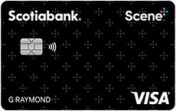 SCENE Visa Card for Students
$100 you’d get
Up to 10,000 Scene+ points.
The full offer at your spending
-
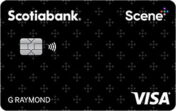 Scotiabank® Scene+™ Visa Card
$100 you’d get
Up to 10,000 Scene+ points.
The full offer at your spending
-
Showing 2 of 2 cards
Filters
Your spending a month
Your balance
How we rank cards
The list is math only: one set of rules, worked out for the choices you made.
What Year one and Every year mean
Year one is what a card is worth in its first year at your spending: the rewards it earns, plus any welcome offer your spending would reach, minus the first year’s annual fee.
Every year after leaves out the welcome offer and takes off the full annual fee, so a big offer can’t hide a weak earn rate.
We rank by the one you pick. When two cards come out the same, the one with the higher score goes first. Values are estimates, rounded to the dollar.
What’s in each spending choice
Each choice is an example month of spending, split across the kinds of spending cards reward differently. Pick the one closest to yours.
- Light, $1,000 a month: Groceries $400, restaurants $100, gas $100, recurring bills $100, everything else (base rate) $250, foreign currency $50
- Typical, $2,500 a month: Groceries $800, restaurants $250, gas $250, recurring bills $250, travel $150, everything else (base rate) $650, foreign currency $150
- Big, $5,000 a month: Groceries $1,200, restaurants $500, gas $400, recurring bills $400, travel $500, everything else (base rate) $1,600, foreign currency $400
How we value points
Each points program gets one value per point, taken from the program’s own valuation. Cards in the same program use the same value, so two cards that earn the same points are judged the same way.
- Aeroplan: 2 cents a point
- American Express Membership Rewards: 1.7 cents a point
- BMO Rewards: 0.67 cents a point
- British Airways Club: 2 cents a point
- Cathay Asia Miles: 1.5 cents a point
- CIBC Aventura: 1 cents a point
- Desjardins BONUSDOLLARS: 100 cents a point
- Flying Blue: 1.9 cents a point
- Marriott Bonvoy: 0.8 cents a point
- moi Rewards: 0.8 cents a point
- More Rewards: 0.2 cents a point
- National Bank a la carte Rewards: 0.9 cents a point
- PC Optimum: 0.1 cents a point
- RBC Avion: 1.7 cents a point
- Scene+: 1 cents a point
- TD Rewards: 0.5 cents a point
- Triangle Rewards: 100 cents a point
- United MileagePlus: 1.6 cents a point
- VIPorter: 1.5 cents a point
- WestJet Rewards: 1 cents a point
A card whose points we can’t value yet shows its points and sorts after the cards we can value.
What Low interest adds up
Low interest ranks by what a year of carrying a balance would cost: interest at the card’s purchase rate, plus the annual fee. It assumes the balance stays the same all year and leaves out rewards and welcome offers.
A balance transfer offer shows on the card when it has one, but it doesn’t change the order.
Does pay change the order?
No. The order comes only from the math above. We get paid when you apply through some links, and a bank can pay to show a card in a spot marked Sponsored. Pay never moves a card in the ranked list or changes its score.
Help me choose
Four quick questions, then a list that fits. Your answers only set the list. We don’t keep them.
Show the questions as a form
Help me choose

Mr. Loonie is typing
Which kind of card fits you?
Start with what you want the card to do. Each one has its own ranked list.
- Cash back Good if you want money off your bill with no points to learn. Watch for the top rate usually covering a few kinds of spending, often with a yearly cap.
- Travel points Good if you fly at least once a year and will use points for flights. Watch for higher annual fees. Points are worth less on merchandise.
- No annual fee Good if you spend under about $1,500 a month or want a backup card. Watch for lower earn rates and fewer insurance perks.
- Low interest Good if you sometimes carry a balance from month to month. Watch for little or no rewards. Paying in full each month saves more than any rate.
- Balance transfer Good if you have card debt to pay down over several months. Watch for a transfer fee and the regular rate once the promo ends.
- No foreign fee Good if you shop in US dollars or travel outside Canada. Watch for an annual fee on most of them. The fee you save abroad can cover it.
- New to Canada Good if you’ve just arrived and have no Canadian credit history yet. Watch for lower limits at first. Some need a Canadian bank account or a deposit.
- Build credit Good if you’re rebuilding your credit after missed payments. Watch for the deposit, which sets your limit. Rewards are small or none.
Cards by bank
Cards by network
Rates, fees and offers come from the card issuers and change often. We work to keep this page accurate and current, but it may contain mistakes, so always check the issuer’s terms before you apply. Values are estimates for the spending you picked, rounded to the nearest dollar.
Spot something wrong? We’ll check it with the bank. Suggest a correction